Muhammad Manamil on January 19, 2026




AI engines are designed to find and synthesize information quickly. To be the source they choose, you must structure your content for Machine Parsability.
The Citation Block: Start every major section with a 40–60 word "direct answer." This is a concise, factual summary that an AI can lift and cite verbatim.
Question-Based H2s: Use exact user queries as your subheadings (e.g., "How much does X cost in 2026?"). This helps AI bots map your content to specific user intents.
Statistical Weight: AI models prioritize content with hard data. Instead of saying "Most users prefer X," say "67% of users in 2026 reported a preference for X."
As AI-generated "spam" content increases, search engines use E-E-A-T (Experience, Expertise, Authoritativeness, Trust) as a filter.
Verified Author Entities: Every post must be linked to a real human expert with a verified Knowledge Graph presence.
First-Person Proof: Include "Experience" signals that AI cannot fake: original photos, specific case study results, and unique personal insights.
Trust & Security: A secure site is a non-negotiable trust signal. Before optimizing your content, ensure your technical foundation is solid by using high-quality SSL check tools to verify your site’s encryption and security status.
Schema markup is the "Nutrition Label" for your website. In 2026, these three are essential for Zero-Click results:
FAQ Schema: Directly feeds the "People Also Ask" boxes and AI Q&A modules.
Organization Schema: Helps AI engines identify your brand as an authority in its niche.
HowTo Schema: Perfect for capturing step-by-step "Zero-Click" snippets for tutorial searches.
Traditional "Traffic" is becoming a secondary metric. In a zero-click world, you must track:
Inclusion Rate: How often your brand is cited in AI Overviews.
Brand Visibility: Impressions in the "Knowledge Panel" or "Local Pack."
Share of Voice: What percentage of an AI's summary is based on your data?
| Metric | Old Way (2020) | New Way (2026) |
| Success | Keyword Rankings (#1-10) | AI Citation Frequency (%) |
| Traffic | Total Organic Clicks | Assisted Conversions (via AI) |
| Authority | Backlink Count (DR/DA) | Entity Relationship Strength |
| Engagement | Bounce Rate | Interaction to Next Paint (INP) |
| Security | "Has SSL?" (Yes/No) | Trust Score (Continuous Auditing) |
Featured Posts
Categories
April 04 2026
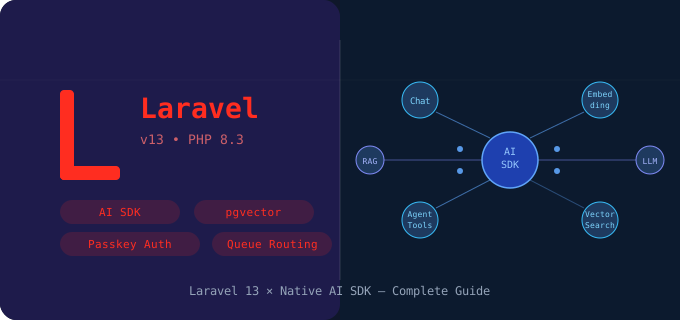
How to Use Laravel 13 AI SDK for Native AI Development Complete GuideLaravel 13 introduces a powerful native AI SDK that transforms how PHP developers build intelligent applications. From AI agents and semantic vector search with pgvector, to passkey authentication and intelligent queue routing — this complete guide covers every major Laravel 13 feature with real code examples to help you ship AI-powered apps faster than ever.
November 10 2025
Laravel 12 Social & Passkey Authentication (AuthKit) – Complete GuideAuthentication is one of the most important parts of any modern web app — and Laravel 12 makes it easier than ever with AuthKit, which supports social logins (like Google, GitHub, Facebook) and passkey authentication (passwordless login using Face ID, Touch ID, or security keys). In this guide, you’ll learn step-by-step how to set up Social Login + Passkey Authentication in Laravel 12 using AuthKit — from scratch.


Built by a developer, for developers — free tools and real-world guides to help you code smarter, faster, and without the guesswork.
© 2026 — manamil.dev. All Rights Reserved.